Pick jobs before comparing troop totals
For an army battle, choose enough protection, damage and support to execute the plan. Troop class affects which skills and positions are useful; the commander’s personal level is mainly a dungeon/personal-combat concern. A larger army is not automatically better if its attacks cannot be used from the selected position.
The table below is a role guide grounded in classic community documentation. Individual skills can change a unit’s use, so read the selected commander’s actual skill list rather than assigning every member of a class the same abilities.
Main classes to recognize
| Class | Typical job to inspect | Formation/skill check |
|---|---|---|
| Samurai | Physical damage | Basic attacks require the front column; check special move cost. |
| Ashigaru | Guarding vulnerable units | Front-column basic attacks; inspect Ally Guard versus All Guard and interception chance. |
| Archer | Ranged pressure | Can act from either column; select a reachable target. |
| Ninja | Fast ranged utility | Can act from either column; interruption or assassination depends on actual skills. |
| Tactician | Initial buffs and support | Intelligence affects buffs; inspect the number and type actually applied. |
| Onmyouji | Magic or defensive shikigami | Intelligence matters; verify the learned attack/protection rather than assuming every unit has it. |
| Miko / Sohei | Healing or support | Intelligence influences healing; confirm the skill and its move cost. |
| Musketeer | Physical ranged-class damage with positional limits | The documented basic attack still requires the front column. |
Other documented troop types include Cannoneer, Knight, Mage, Cavalry, Animal and Monster. They have distinct skills and class bases, but this guide does not invent an exhaustive matchup matrix or treat a rare recruit as part of every opening.
Match the lineup to the enemy problem
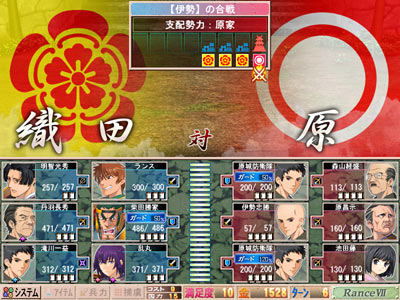
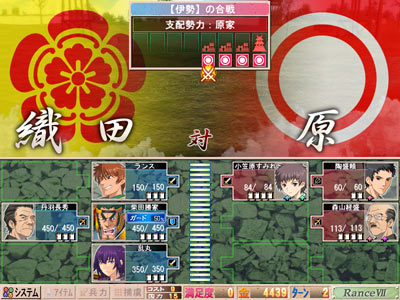
Your damage unit is being hit first: inspect Guard coverage and positions. Ashigaru protection is tied to its actual skill and can weaken after repeated hits. Put the unit you need inside that coverage, and monitor its guard percentage instead of assuming the whole party is safe.
Enemy preparation is about to complete: inspect Ninja interruption skills and remaining battle moves. The move banners tell you whether a planned interruption is possible. A class name alone does not guarantee that a specific commander has the right action.
Enemy armor makes physical attacks inefficient: inspect available magic rather than adding soldiers blindly. Onmyouji/Mage damage depends on Intelligence and the learned attack. Enemy Intelligence also matters to magic defense. There is no universal “magic always wins” rule.
You are ahead on the victory bar late in the fight: preserve the lead. Army battles can end on advantage when the clock runs out, so a defensive action or conserving a crucial unit may be better than a costly finishing attack. See advantage versus adjustment.
Intelligence is not only for attacking mages
The community formulas assign different jobs to Intelligence: it affects Ashigaru interception, Tactician buffs, magical attack/defense and Miko/Sohei healing. Attack, Defense and Intelligence are therefore not interchangeable scores.
Before choosing an upgrade, identify the actual bottleneck. An Ashigaru that repeatedly fails to intercept has a different problem from a Samurai whose attack cannot reach the intended target. Upgrading the highest-looking stat without this check can leave the problem unchanged.
Build a workable opening team
For an early first campaign, start with the jobs your existing roster can perform:
- Put a defender where its skill protects your important damage units.
- Give front-only attackers legal positions.
- Keep a ranged option for targets your front cannot conveniently reach.
- Add support if its buff/heal helps the actual encounter.
- Reserve enough available commanders for the enemy turn.
This is an editorial assembly checklist, not a fixed six-unit formation that works in every battle. Rance’s troop annihilation is a documented first-run Game Over risk, so protecting him matters more than adding an optional attacker.
Army class versus dungeon performance
In army combat, troop count acts as unit HP and casualties are tied to troop attacks. In personal battles, commanders use individual HP, level and personal skills. A unit that contributes strong campaign utility or guarding can be valuable without being your best dungeon damage dealer.
Use stats and levels for the distinction, army formation for the move clock, and dungeon battles before sending the same lineup underground.
Sources & version scope
- Community Game mechanics — troop positions, Guard and battle resources.
- Community Parameters & Formulae — class list and attribute roles.
Sources checked 2026-10-08. Classic-system role comparison; Steam mechanics and translated skill names are not independently tested.