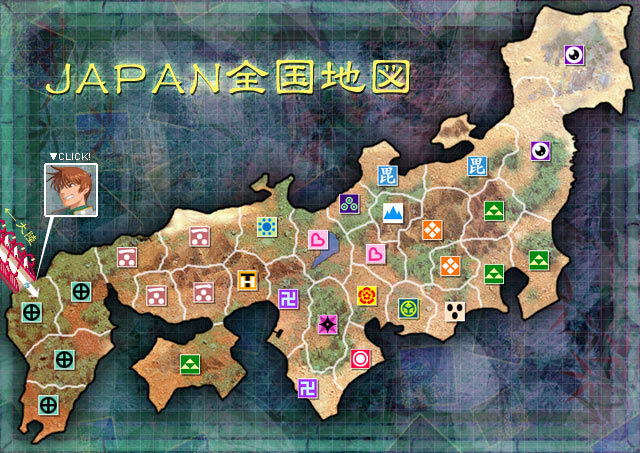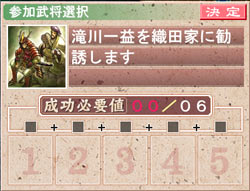
Your first campaign in five steps
This opening follows documented classic-game mechanics, not a tested Steam turn script. The Steam release can use different event presentation and names. Follow the current command and its requirements when a label differs; the version comparison shows which details are confirmed and which still need checking.
| Step | Where to act | What success looks like |
|---|---|---|
| 1. Open the prison | Visit the prison in Owari | Ordinary defeated commanders can become prisoners. |
| 2. Inspect your army | Commander list and troop controls | You know which units attack, which guard, and who remains for defense. |
| 3. Prepare the first war | Hara declaration command | Required Negotiation is met and the Hara front is active. |
| 4. Fight for Ise | Hara attack command and battle lineup | You win a territory while keeping an army available for the response. |
| 5. Review the turn | Prison, troop menu and province commands | Useful prisoner persuasion and reinforcements are checked before End Turn. |
1. Unlock captures before pursuing recruits
Select Owari and visit its prison before building an opening around captures. The community walkthrough also records automatic prison unlocks after certain story or automatic-capture events, but visiting it deliberately removes an avoidable early uncertainty.
After a battle, check the prisoner list rather than assuming every defeated commander joined your army. A captured unit still needs persuasion, capacity and sometimes a character event. Follow the recruitment diagnostic when any stage is missing.
2. Build a lineup around jobs
Your initial roster includes Rance and Ranmaru for Samurai damage, Katsuie Shibata as an Ashigaru defender, and Nagahide Niwa as an Archer. Give the defender a position where its actual Guard skill protects the units you need. Place front-only attackers in the front column; inspect skills before placing someone behind another unit.
An army battle spends troop count and battle moves. Dungeon fights instead use personal HP and level. Raising a commander’s personal level is not the same as adding soldiers. The unit-type guide helps choose jobs, while the army formation guide explains the battle clock and victory bar.
Two first-run failure checks matter more than winning quickly: the legacy walkthrough records a Game Over if Rance’s army unit is annihilated or Owari is conquered. Watch his troop count and leave a workable defensive response. Do not spend every available commander on an optional attack simply because an action fan remains.
3. Use Hara as a manageable first front
The classic walkthrough makes Hara’s declaration available from turn 2 with 10 Negotiation. Find the declaration command, select commanders to satisfy the requirement, and confirm that you can still field the army you intended afterward. This is an earliest eligibility rule, not a promise that every edition has the same turn-by-turn opening.
Ise contains multiple territories. Winning one fight does not necessarily remove the clan. Between attacks, check troop losses, prisoners and defenders before spending the next fan. Completing Hara’s conquest automatically captures Shouji Hara in the documented route, while other commanders can have different capture conditions. Read the Hara opening for the conquest-specific checks.
4. Spend map actions separately from free menu work
The classic first campaign starts with two map Action Fans. Most province events, attacks and searches consume them, and unspent fans do not carry into the next turn. The tiny banners underneath battle units are a different resource.
Prison persuasion and buying troop replenishment do not spend map fans in the community mechanics. They still need available commanders, money or capacity. Before End Turn:
- Finish the required story or campaign objective for this turn.
- Inspect captured prisoners and contribute spare Negotiation where useful.
- Replenish the troops needed for defense if funds allow.
- Check the remaining fan and available events, then save before ending.
At 50 Satisfaction, an eligible classic bonus gives an extra map action starting the next turn, provided Sill is available and the initial extra-fan bonus has not already been supplied by a Second Game bonus. Later fan bonuses have separate requirements. Use the Action Fans checklist for thresholds and the Satisfaction guide for choosing rewards.
5. Save at decisions, not only at the end
Keep a turn-start save and a separate save before a conquest, route event or difficult battle. Record the current gourd count, commander availability and event name. These give you a useful recovery point when a walkthrough and your game differ.
A first clear follows Official History, also called the True Route, in the documented classic game. Do not mix its objectives with an IF-route or Second Game opening. Continue with the True Route checkpoints when the gourd sequence or story objectives become your main task.
Watch the official presentation
Sources & version scope
- AliceSoft community Wiki — Game mechanics — map commands, actions, formation and prison work.
- AliceSoft community Wiki — Walkthrough — Oda, Hara and first-run conditions.
- Steam product page — current product identity and broad gameplay description.
Source review: 2026-10-08. Classic mechanics are attributed; no first-hand Steam playtest is claimed.